
Animal Encounters in Death Valley National Park
by Birgitta Jansen
2014 – Late Spring: Skidoo Area, Death Valley National Park
The temperature is comfortable and there is no wind. Gently undulating hills are covered in sagebrush and other desert shrubs. The scent of drying vegetation hangs lightly in the air. We haven’t had rain in a while. Picturesque cumulus clouds grace the deep blue sky. Far to the west some horsetails warn of unsettled weather in the near future.
I amble cross country to the road where the truck is parked. I love being in this place, especially on a quiet day like this when the silence feels almost palpable. The only sounds are my footsteps on sand and patches of gravel between sagebrush.
An explosion like a gunshot. Silence torn to shreds. My heart feels like a metronome on fast forward. I catch a glimpse of an animal bolting out of a sage bush right next to me. By the time I gather my thoughts, I see only a blurry speck in the distance, flying through the landscape. A jackrabbit. Then I understand what happened.
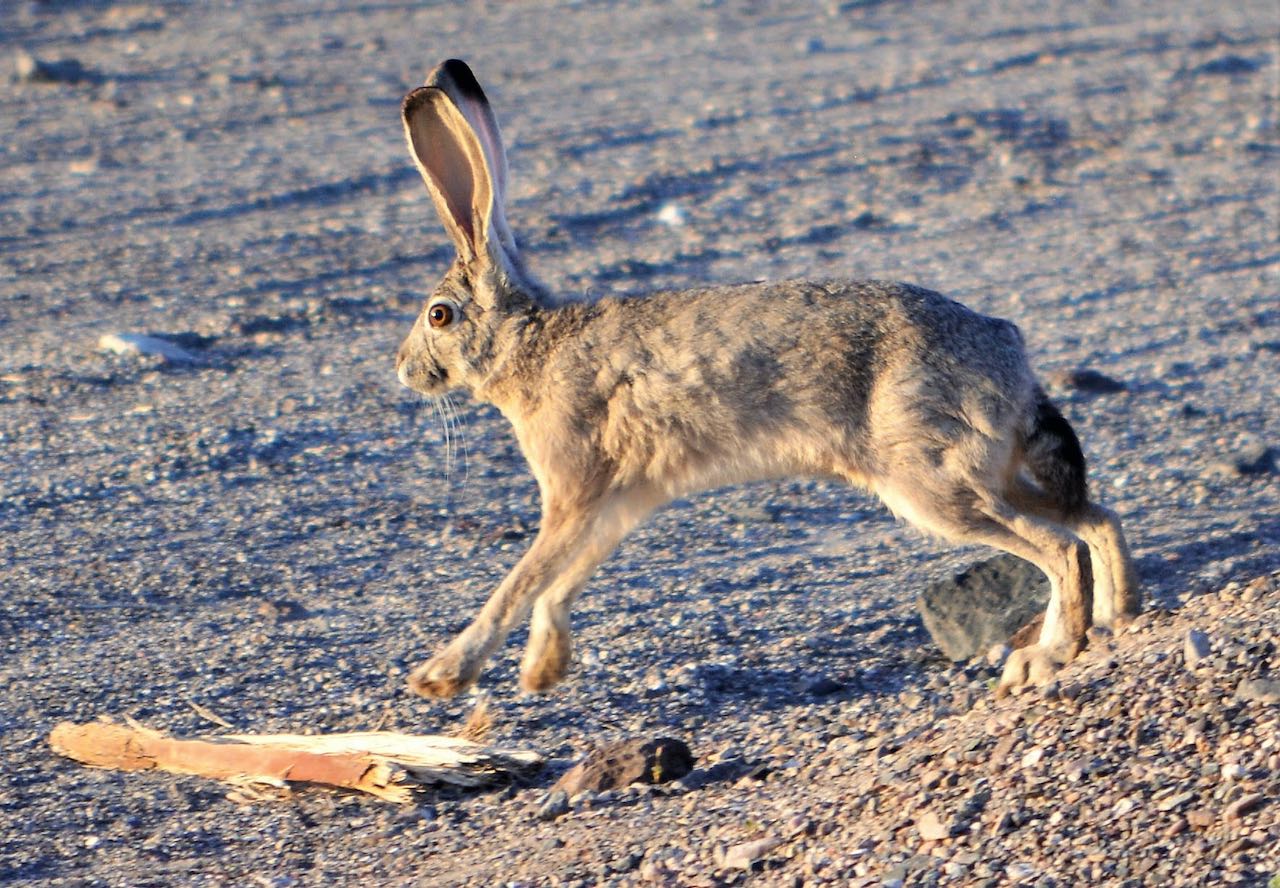
I have rudely disturbed this animal’s peace and quiet. Black-tailed jackrabbits are mostly nocturnal and spend their days dozing in a scratched out depression under a bush. Their sleep is light because they can never fully relax.1
The jackrabbit’s world is filled with danger from sky and land in a way we cannot begin to imagine. What would it be like to live in a world where nothing can be trusted? Where one needs to be on high alert 24/7 for one’s entire life? Jackrabbits are never totally safe, and they know it. The problem, albeit from a jackrabbit’s perspective, is that they are viewed by many carnivores and omnivores as nature’s ideal prey. Eagles, hawks, and owls patrol the skies looking for food below. Wolves, coyotes, foxes, bobcats, badgers, and weasels, to name a few, roam the landscape.2
In order to survive, the jackrabbits had to evolve with significant adaptations to the reality of their world. For example, their auditory abilities are remarkable. The ears are probably the first thing one notices when seeing the animal. They can grow up to eight inches in length. and are almost the same length as their powerful hind feet.
Their ears are a superb early warning system because they are exquisitely sensitive, and shaped to efficiently capture and locate sounds.
Photo by Rod Colvin
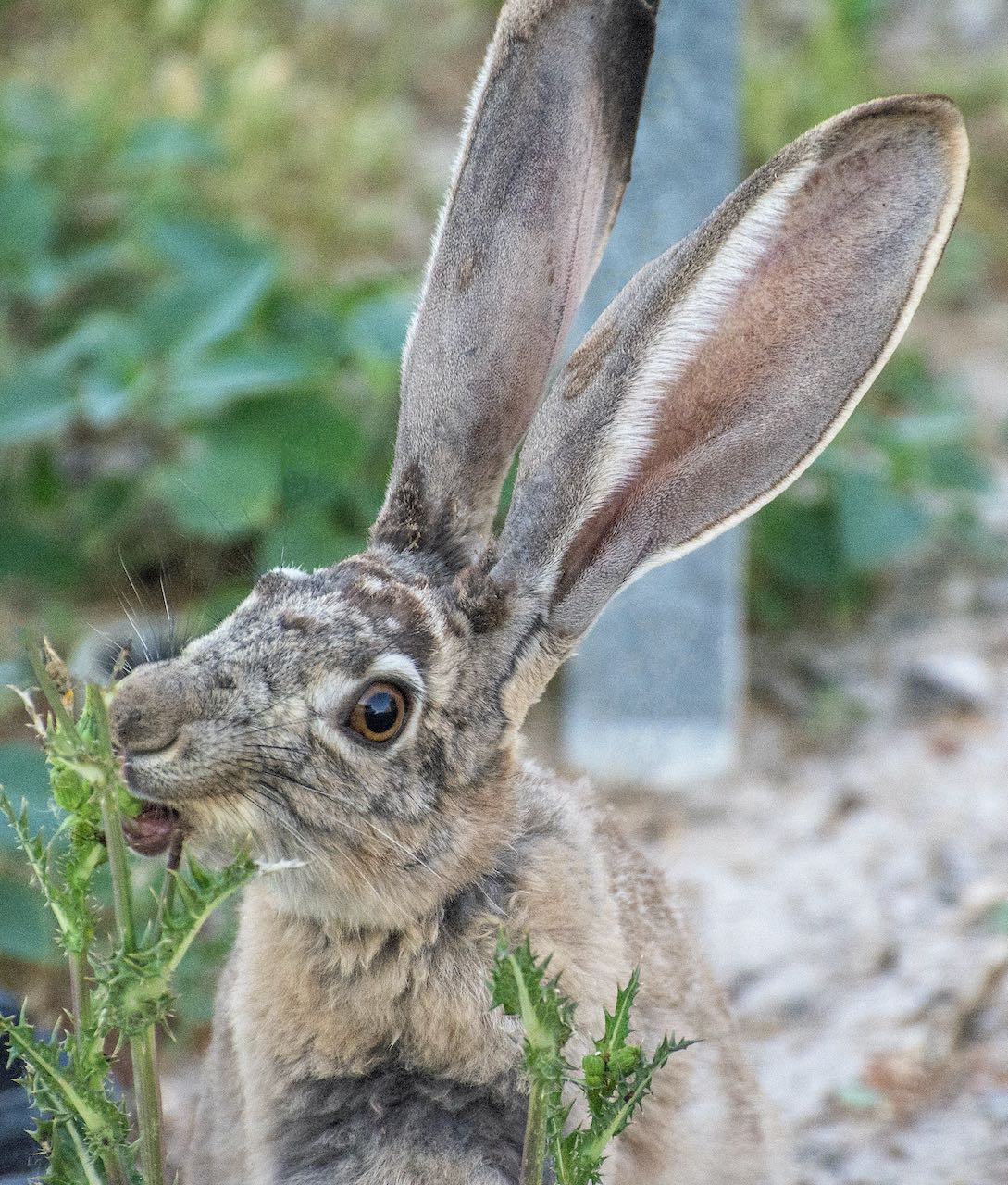
Their visual ability is equally important. Unlike predators, who have eyes located in the front of their faces, a typical characteristic of prey animals is that they have eyes on both sides of their head. This eye placement allows for an almost 360-degree field of vision.4 If you’re a jackrabbit, that’s an ideal arrangement.
And there’s more. Since almost all aspects of the jackrabbit’s behavior and characteristics have to be are about survival, this means that their phenomenal ability to reproduce is a necessity. They are polygynandrous (males and females can have multiple partners)5 and they could be described as lusty creatures. But for jackrabbits procreation is serious business. The mortality rate of the young ones, called leverets, is high. Not many survive their first year due to disease or predation. In warmer climates jackrabbits can mate year around and tend to have two to four litters annually with, on average, four leverets. They can give birth to between two and seven leverets but much depends on the favorability of their environment.6
The females do not build nests but give birth in shallow depressions under cover of shrubbery, called “forms.” They might even put the leverets in different places to increase chances of survival for at least a few. The mothers don’t stay with the little ones but come twice a day to nurse them at dawn and dusk.7
Another advantageous characteristic is that the leverets are precocial: they are born with a full coat of fur, eyes wide open, and they are mobile within minutes. Not long after their birth they can fend for themselves.8
The coloration of the jackrabbit’s fur, called “agouti,” is dark buff peppered with black.9 Especially in a desert environment, this is useful camouflage.
But jackrabbits’ best and most remarkable defense is the incredible speed they’re capable of. They can run 35 to 40 mph.10 and cover between 10 to 20 feet in a single bound.11 Their run might include “hooking” which is another evasive tactic and refers to running in a zig-zag pattern.
I once heard a Tae Kwon Do instructor emphasize to his students: “Best defense, not be there.” It’s the jackrabbit’s mantra.
Summer 2016 – Hidden Valley, Death Valley NP
I am driving southbound on a dirt road through Hidden Valley. This is not a road I have driven often, and I am enjoying the remoteness of it. The human footprint is minimal. Here and there an old road leads to a long ago mining operation now only of historic interest. The landscape in the valley consists of typical desert shrub and gently undulating hills. The Cottonwood Mountains are to the east and the southern reaches of the Last Chance Range are to the west.
I notice a furry little body on the road. It’s a jackrabbit stretched out as if still in mid-run. I get out of the truck to check if the creature is still alive, but it looks like death by vehicle. Some vehicles run these back roads too fast for some wildlife to get out of the way. But a jackrabbit?
I had not seen another vehicle on this road but it must have happened recently. Ants and ravens have not yet found her. There’s blood around the nose and mouth. Her front legs are reaching out to a future she will not have. But her body will soon contribute to the survival of others in this harsh and unforgiving environment. Still, as I look at this lifeless body, I feel sad.
I get back in the vehicle and continue. Within a short distance I see another jackrabbit on the opposite side of the road sitting motionless next to a burrow in the berm. That’s odd, because jackrabbits do not dig burrows12 although they might use a vacant one to escape a predator.
Since the animal is to my left, I have the opportunity to observe it while I slowly move forward. It shows not a hint of awareness to my presence. No movement. This is unusual. I slow to a near stop. The jackrabbit looks forlorn, diminished. Is it possible the animal is grieving? Jackrabbits tend to be solitary animals, although they often forage in pairs or groups at dawn and dusk.13 And then of course, there’s courting time. But do these animals develop social relationships? There has been considerable research on jackrabbits, but this question remains unanswered.
Somehow this little story, seemingly so insignificant, remains vivid for me. Some people might say, “It’s just a jackrabbit, why all the fuss?” But it touches me. Even in this protected area – their territory, their home – they’re still at risk when encountering humans.
Jackrabbits are not an endangered species. In fact, their population is cyclical and peaks every six to ten years. However, from time to time their population crashes. This is often due to the disease tularemia. 14 Fortunately, they quickly recover due to their remarkable fecundity.
But as with so many species, there is a downward trend in numbers.15
One of the five North American species, the Tehuantepec jackrabbit, a Mexican endemic, is already “considered by some conservation biologists to be one of the most endangered animals on earth.”16 We don’t think of jackrabbits’ populations as dwindling, but they are rapidly losing habitat as mining, industrial solar developments, and wind farms encroach on hitherto undeveloped desert lands.
Summer 2016: Saline Valley Road, North Pass area, Death Valley NP
I am working in the backcountry once again. The day of work is done. I’ve set up camp, enjoyed my freeze dried chicken Teriyaki, and called Death Valley dispatch on the sat phone to let them know where I’m camped. All is well in my little world.
It’s early in the evening, the air is silky, the sun no longer a burning orb in the sky. There’s not a hint of a breeze. I’m exploring the area around my camp. When I come to an open area between the piñon pines and junipers, I stand still to listen to the silence. A silence without any ambient noise is to be cherished. We have so little of it.
Suddenly I sense a movement slightly behind me to my left. Slowly I turn my head and see a jackrabbit. She is about eight feet away from me. Neither one of us moves. I wait. I am curious to see what she might do next. She hops a few times. Hops again. She seems relaxed. Is she curious too? Then she leisurely continues to hop forward in a straight line until she suddenly makes a 90-degree right turn and slowly starts to cross the open space in front of me. She is now approximately seven or eight feet from where I am standing. When she is before me, she stops. It feels as if she is observing me while I am observing her. The world she inhabits is as unknowable to me as my world is to her. But when, in this timeless moment, her gaze meets mine, there is a bridge between two different worlds. It’s all that exists. There is reciprocity. She sees me and I see her. I read somewhere that there is intimacy in the act of observation. Perhaps there is.
And then there’s something else. When she hops, I hear her powerful hind feet plop down on the dun-colored sunbaked earth. It dawns on me that when we talk about jackrabbits, we talk about seeing one. But I’ve never heard it said, “I heard a jackrabbit hop.”
She continues ….. plop….. plop….. plop….. until she reaches the brush to my right. At an easy pace she disappears into the vegetation.
Birgitta Jansen has been an active volunteer in Death Valley National Park. Currently residing in British Columbia, she is a managing editor of the Desert Report, has written previously on a number of environmental topics, and has completed a book about the October 2015 flash floods in Death Valley NP.
